
Why Some Parts of Your 4WD Rust Faster Than Others
Rust rarely appears evenly across a 4WD. A large flat panel may stay in good condition while a bracket, seam or chassis opening nearby starts showing corrosion. The difference usually comes down to exposure, drainage, surface damage and the type of metals touching each other.
Understanding those factors helps you inspect the right places and deal with small issues before they become expensive ones.
Rust needs more than bare metal
Rust forms when iron or steel reacts with oxygen and moisture. Salt does not create rust by itself, but dissolved salts increase the conductivity of water, which can accelerate corrosion. The Australasian Corrosion Association's corrosion fundamentals explains how salt solutions act as electrolytes in the corrosion process.
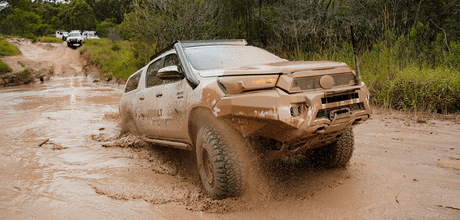
This is why a dry-looking vehicle can still have corrosion developing underneath. Mud, sand and debris can hold moisture against metal long after exposed panels have dried. The Australasian Corrosion Association's guidance on corrosion in cars specifically notes that damp dirt can allow corrosion to continue after the rest of the vehicle is dry.
Why some 4WD parts rust faster
1. Seams and joins hold moisture
Folded edges, overlapping panels, welds and bolted joins create small gaps where water and fine dirt can settle. Airflow is limited inside those gaps, so drying takes longer. If a protective coating does not fully reach a seam, exposed metal may also have less protection than the surrounding surface.
Inspect pinch welds, body mounts, welded brackets, tray mounts and seams around guards. Look for staining that begins at an edge rather than in the middle of a panel.
2. Chassis rails collect what the body sheds
Openings in chassis sections allow water, sand and mud to enter. Drain holes are designed to let that material out, but heavy build-up can slow drainage or block it completely. The outside of the rail may look clean while damp material remains inside.
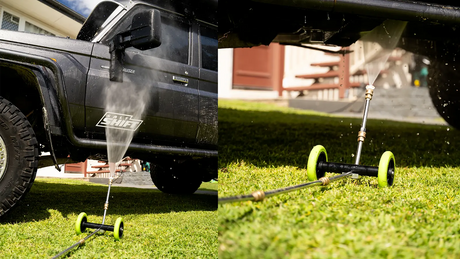
After beach or muddy driving, pay attention to what exits the chassis during flushing. Continued dirty runoff is a sign that more material was sitting inside than the exterior suggested. A purpose-built 4x4 Magnetic Chassis Flusher helps direct water through internal chassis sections that are difficult to reach with a normal hose nozzle.
If your 4WD regularly sees sand, mud or coastal conditions, our guide to why underbody cleaning is essential for your 4WD goes deeper into the areas that are commonly missed during a normal wash.
3. Stone chips break the protective layer
Factory paint, galvanising and underbody coatings help separate metal from moisture and oxygen. Gravel, sand and track debris can chip those barriers, particularly on leading edges and low points. Corrosion can then begin at a small break and spread beneath the surrounding coating.
Check crossmembers, bash plates, suspension mounts, diff housings and the forward-facing edges of brackets. A torch makes small chips, lifting coatings and early staining easier to spot.
4. Different metals can react
When dissimilar metals make electrical contact in the presence of an electrolyte such as salty water, galvanic corrosion can occur. One of the metals can become more likely to corrode than the other. Accessories, replacement fasteners and poorly isolated mounts can introduce combinations that were not part of the original vehicle design.
The Australian Stainless Steel Development Association explains that galvanic corrosion requires a conductive liquid, electrical contact between the metals and a sufficient difference in their electrochemical potential. Salt contamination increases the conductivity of the moisture around the join.
This does not mean different metals can never be used together. It means the correct fasteners, isolating materials, coatings and installation methods matter. If corrosion appears around a newly fitted accessory, bracket or bolt, have the installation checked.
5. Heat and movement damage protection
Heat, vibration and flex can age protective finishes or cause them to separate from the surface. Moving suspension components also experience abrasion from dirt and debris. Areas around heat shields, exhaust hangers and high-movement mounts deserve regular inspection.
Keep in mind that corrosion protection products have their own application limits. For example, 4x4 Rust Shield is intended for suitable chassis, underbody and exposed metal surfaces and should not be applied to engines, exhaust components or brakes. Always follow the product directions before application.
6. Poor drainage changes everything
A clear drain allows water to leave. A blocked one can turn a cavity into a moisture trap. Mud, sand and debris can restrict drainage, while an incorrectly applied thick coating or sealant can also interfere with factory drainage points.
Avoid deliberately covering factory drains. If you are unsure whether an opening is a drain, access point or protected cavity, check the vehicle handbook or manufacturer information before probing or modifying it.
High-risk rust areas to inspect on a 4WD
- Inside and around accessible chassis openings
- Panel seams, pinch welds and folded edges
- Body mounts, brackets and crossmembers
- Stone-chipped leading edges
- Suspension mounts and exposed fasteners
- Accessory mounting points
- Areas hidden behind bash plates or guards
- Drain points and low sections where water can collect
- Trailer plugs and exposed electrical connections
If you have just come back from the beach or a muddy trip, do not limit the inspection to obvious orange surface rust. Look for trapped material, damaged coatings, blocked drains, lifting paint and staining around joins. These can all point to areas that need attention before corrosion becomes more established.
A practical 4WD rust prevention routine
Start with access. Remove trapped dirt, flush internal sections where the vehicle design allows and clean the exposed underbody. An Undercarriage & Chassis Wash can help remove salt, mud and grime from the areas underneath the vehicle where build-up tends to remain.
Let the vehicle drain and dry completely, then inspect the existing protective finish. Treat active rust appropriately before applying any coating over the area. Protective products work best as part of a clean-and-maintain routine, not as a way to hide existing contamination or corrosion.
Where Salt Shift can help
Once the inspection and cleaning work is complete, Salt Shift can support the maintenance side of the routine.
- The 4x4 Magnetic Chassis Flusher helps move salt, sand, mud and grime from accessible internal chassis sections.
- The Undercarriage & Chassis Wash is designed for deeper cleaning of chassis, suspension and underbody areas.
- Once suitable surfaces are properly cleaned, completely dry and prepared, 4x4 Rust Shield creates a hydrophobic protective barrier for chassis, underbody and exposed metal surfaces.
Rust Shield does not replace proper rust repair. Existing corrosion should be assessed and treated appropriately before a protective coating is applied. Follow the application instructions, including surface preparation, tack time and full cure time before returning the vehicle to wet, beach or off-road conditions.
Frequently asked questions
Why does rust start around bolts and brackets?
Bolts and brackets create joins where water and dirt can collect. Coatings may also be damaged during installation, and some accessory or fastener combinations can introduce dissimilar metals. Check the fastener, surrounding coating, drainage and installation if rust repeatedly appears in the same spot.
Can rust spread underneath paint?
Yes. Corrosion can begin at a chip, scratch or exposed edge and continue beneath a coating. Bubbling, lifting paint or staining that appears to be coming from underneath the finish should be inspected rather than simply coated over.
Does surface rust mean the chassis is unsafe?
Not automatically. Light surface corrosion and structural deterioration are not the same thing. Deep scaling, cracking, perforation or significant corrosion around chassis sections, suspension points or other load-bearing mounts should be assessed by a suitably qualified professional.
Where should I check for rust after beach driving?
Start with chassis openings, seams, crossmembers, suspension mounts, fasteners, bash plates, drain points and any accessory mounts underneath the vehicle. These areas are more likely to trap salty moisture, sand or mud than large exposed body panels.
Can I apply rust protection over existing rust?
Do not use a protective coating as a substitute for correctly preparing active rust. Clean the area, assess the corrosion and carry out any required treatment or repair first. Once the surface is suitable, clean and completely dry, apply the protective product according to its directions.