
Rust Shield vs Lanolin: What’s the Difference for 4WD Rust Protection?
If you spend enough time around 4WDs, particularly ones that see beaches, coastal roads or wet tracks, you will eventually hear the same debate: lanolin or a curing rust-protection coating?
Both are used to help protect exposed metal from moisture and corrosion, but they do not necessarily behave the same way once applied.
Understanding that difference makes it much easier to choose a protection method that suits how you actually use your 4WD.
Why Protect a 4WD Chassis in the First Place?
Steel needs the right conditions for corrosion to occur, with moisture and contaminants such as salt accelerating the process.
The underside of a 4WD regularly deals with exactly those conditions.
Beach driving can expose the chassis, suspension, crossmembers, brackets and other components to saltwater, salt spray and wet sand. Mud can also collect in cavities and around components, holding moisture against the surface long after the trip is finished.
That is why good underbody maintenance generally comes down to two separate jobs:
- Remove contaminants.
- Protect clean metal from further exposure.
A protective coating should not replace cleaning.
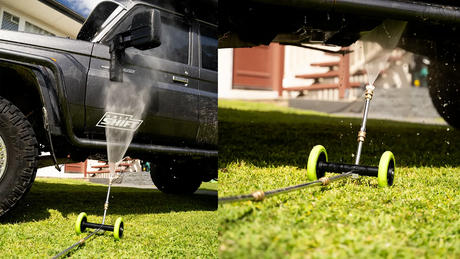
If your 4WD has been on the beach or through heavy mud, start by thoroughly cleaning the exterior and the areas underneath. A dedicated Undercarriage & Chassis Wash can help remove salt, mud and grime from areas a normal exterior wash may miss.
For boxed chassis rails, a Magnetic Chassis Flusher can also help move water and cleaning solution through areas that are otherwise difficult to reach.
Once the vehicle is clean and dry, you can think about protection.
What Is Lanolin Rust Protection?
Lanolin is a naturally derived waxy substance obtained from sheep's wool.
Lanolin-based corrosion products use these water-resistant properties to leave a protective film over metal.
Depending on the formulation, that film may remain relatively soft or tacky rather than curing into a hard coating.
That can make lanolin useful across a wide range of applications, including machinery, trailers, tools, marine equipment and vehicle components.
Lanotec, for example, describes its lanolin corrosion inhibitors as forming a non-evaporative protective film designed to resist water, salt and wash-off. Read Lanotec's technical guidance on lanolin corrosion protection
Advantages of Lanolin Protection
Depending on the particular product, lanolin coatings can offer:
- Water resistance
- Corrosion protection
- Good penetration into seams and difficult areas
- A coating that remains flexible
- Easy maintenance and reapplication
Because some lanolin products remain softer, they can also continue coating a surface rather than forming a rigid film.
The exact behaviour varies significantly between formulas, so always follow the instructions for the lanolin product you are using.
What Is Salt Shift Rust Shield?
Salt Shift Rust Shield takes a different approach.
Rust Shield is an oil-based, non-lanolin formula that is sprayed onto clean, dry metal and then allowed to cure.
Once cured, it forms a hard, glossy, hydrophobic and non-stick protective barrier designed to reduce direct exposure to moisture, salt and grime.
Rather than intentionally staying soft or sticky, the aim is to create a cured protective finish.
For a standard 4WD, Salt Shift recommends approximately 250 to 350 mL for full underbody coverage. More product is not necessarily better. Applying the coating too heavily can interfere with curing and performance.
Rust Shield should tack dry in around three hours, with approximately three to four days allowed for full curing before beach driving, trail driving, vessel launching or wet-road use.
Depending on vehicle use and conditions, Salt Shift lists typical protection at around six to 12 months. Vehicles regularly exposed to beaches, salt or aggressive off-road use may require more frequent touch-ups.
Rust Shield vs Lanolin: The Main Differences
The biggest difference is not simply whether one "prevents rust better".
It is how the protective layer behaves.
|
Rust Shield |
Lanolin-Based Protection |
|
|
Base |
Oil-based, non-lanolin formula |
Derived partly or primarily from lanolin |
|
Finish |
Cures hard, glossy and non-stick |
Commonly leaves a softer protective film |
|
Water resistance |
Hydrophobic |
Water resistant |
|
Dirt adhesion |
Designed to cure non-stick |
Depends on formulation and film thickness |
|
Reapplication |
Check coating condition and hydrophobic effect |
Typically reapplied as part of routine maintenance |
|
Typical use |
Chassis, suspension and exposed underbody metal |
Wide range of metal, mechanical and equipment applications |
|
Preparation |
Clean and completely dry surface |
Product-specific, but clean surfaces generally improve performance |
There is no single corrosion product that is automatically the right choice for every component or vehicle.
The better question is what behaviour you want from the protective layer.
When a Hard-Curing Coating Makes Sense
A curing coating can suit someone who wants a more permanent-feeling finish across large exposed sections of the chassis and suspension.
Once Rust Shield has fully cured, the surface should feel hard and non-stick rather than greasy.
That can be particularly useful on a touring or beach-driven 4WD where the owner wants to:
- Protect exposed metal
- Reduce direct moisture contact
- Avoid a permanently sticky underbody coating
- Make future dirt and grime easier to rinse away
- Check protection visually and through water behaviour
Salt Shift recommends monitoring the coating's hydrophobic effect. If water no longer beads or rinses away in the same way, or heavily exposed areas have been physically worn, those sections may need to be topped up.
When Lanolin May Make Sense
A lanolin product may be useful when you specifically want a softer, penetrating corrosion-inhibiting film.
It may suit applications such as certain mechanical components, cavities, tools, trailers and equipment where a flexible or penetrating coating is preferred.
Some lanolin formulas are also designed for electrical or moving components, although compatibility depends entirely on the product being used.
Again, always check the manufacturer's instructions before applying any corrosion product around electrical systems, rubber, plastics or moving parts.
Can You Use Both?
Potentially, but not necessarily on top of each other.
Different protective coatings rely on different surface conditions to adhere and perform properly.
For Rust Shield, the target metal should be clean, dry and free from grease or residue before application.
Applying it over a greasy, waxy or lanolin-coated surface may prevent it from bonding and curing as intended.
If you are changing protection systems, thoroughly clean and prepare the area first rather than simply spraying one coating over another.
Surface preparation is one of the biggest factors affecting coating performance. The Australasian Corrosion Association notes that cleaner, properly prepared steel generally provides better coating adhesion and durability.
Cleaning Still Comes First
Whichever protection system you choose, do not use a protective coating as an excuse to leave salt and mud underneath the vehicle.
After beach driving or exposure to salty conditions:
- Rinse away loose contamination.
- Clean the underbody thoroughly.
- Flush chassis rails and hidden areas where practical.
- Allow surfaces to dry.
- Inspect your existing protective coating.
- Touch up protection where required.
Exposure is more important than sticking to a fixed washing schedule.
For vehicles that regularly see salt, mud and beach conditions, the Ultimate 4x4 Wash & Protection Kit combines the cleaning, chassis flushing and protection stages into one maintenance system.
So, Is Rust Shield or Lanolin Better?
They are different ways of approaching corrosion protection.
Lanolin-based products generally rely on a persistent water-resistant film.
Rust Shield is designed to cure into a hard, hydrophobic, non-stick protective coating.
The right option depends on the surface you are protecting, the finish you want and how the vehicle is used.
What matters most is that you clean first, protect second, and continue checking the areas that receive the most exposure.
No coating makes a 4WD maintenance-free.
But keeping salt, moisture and grime off exposed metal gives your chassis a much better chance of staying in good condition for the long haul.
FAQs
Is Rust Shield lanolin based?
No. Salt Shift Rust Shield is an oil-based protective formula but it is not lanolin based.
Does Rust Shield stay sticky?
Rust Shield is designed to cure into a hard, glossy and non-stick finish. It should be allowed approximately three to four days to fully cure before beach, trail or wet-road use.
How long does Rust Shield last?
Typical protection is around six to 12 months depending on driving conditions and vehicle use. Frequent beach or off-road driving can require more regular maintenance.
Can I put Rust Shield over lanolin?
Rust Shield should be applied to a clean, dry surface free of grease and contamination. Existing lanolin or oily residue should therefore be properly removed before applying Rust Shield.
Should I wash my 4WD if it already has rust protection?
Yes. Rust protection does not eliminate the need to remove salt, mud and grime. Cleaning and protection perform different jobs.